Showing posts with label Petra. Show all posts

2010/11/19

2006.05.21_Petra 9 - Black and White


The Siq


Eroded Cave Dwellings


Royal Tombs


Inside a Royal Tomb


Treasury

2006.05.21_Petra 7 - Snake Monument & Birdeye View of Treasury


At around 14:30 we arrived at the Snake Monument, the destination of one of the longer hikes a tourist can take in Petra. It took us a while to actually locate the snake monument. In fact, we finally saw the monument only because a local pointed it out for us. At the Snake Monument, we encountered a Bedouin family who still lives at the monument site. He asked us if we wanted tea. We thanked him but we didn't accept his offer. There were two kids at the black tent (probably made with goat hair according to traditions), at around 6-8 years old. We played football (soccer) with them for about 10 minutes before heading back.

When we reached the Main Temple, we decided to hike up the hill opposite to the famous Treasury to have a birdeye view of the magnificent monument. We found our way uphill again near the Royal Tombs. The steps were steep, and the hike took approximately 45 minutes. The view was fantastic. Up on the hill, we saw the local guide and the professor again (the first time near Tomb of Soldiers). After taking some photos, we slowly descend down. Both AK and I got ourselves a can of pop. It was very refreshing. Without it, we probably would take us 2 times longer to reach the exit of Petra. At night we dined at Sand Stone Restaurant, and went online at the computer room in Petra Moon.

2006.05.21_Petra 6 - Rock 2


Near the Tomb of Soldiers we found some of the most impressive rock patterns in Petra (in my opinion). On our way to the Snake Monument, we had a few biscuits and a few sips of water for lunch.

2010/11/18

2006.05.21_Petra 5 - High Place of Sacrifice & Soldier's Tomb


We left Petra Moon Hotel at around 08:30. We entered Petra along the same route as the day before, through the Siq and passed by the Treasury. Before we reached the Theatre, we took a stepped path uphill. Our first destination was the High Place of Sacrifice. The hike took about an hour up the hill behind the Royal Tombs. The view down from the hill towards the ruins was great. We finally reached the high alter where ancient Nabateans made sacrifices to their gods. It is an open area with a raised platform for sacrificial ceremonies. We didn't have enough knowledge on ancient sacrifice to fully understand the layout or retrace the ancient procedures. We didn't stay long.

From High Place of Sacrifice we walked west toward Wadi Farasa and Snake Monument. On our way, we passed by the Tomb of Soldiers. Because of the Roman uniform on the statues, many believe that the tomb belonged to some Roman officers in the 2nd Century. Though some historians also argued that many architectural elements of the tomb facade predated the Roman Conquest of Petra, and the tomb was probably constructed in the 1st Century.

2006.05.20_Petra 4 - Rock


It was mid-afternoon and we got time to visit two more lookout points uphill to see the arid valley scenery surrounding Petra. Just like the ruin itself, the views of the surrounding were dramatic. On our way out we stopped by more royal tombs and small cave dwellings. We were exhausted from the return hike and heat but we could still get excited and rush to take photos when we encountered rocks with unique patterns. From the ruins of the civic centre it was another 2km before we reached the visitor centre. Everyone seemed to be leaving at the same time, by horses, by donkey carts, by feet and so on. In the evening we had dinner at Red Cave Restaurant. After the meal I walked up to the village of Wadi Musa by myself to the Internet café.

2006.05.20_Petra 3 - Royal Tombs, Theatre and Monastery


Photos: Royal Tombs (1+2), Theatre, Steps to Monastery, Monastery

After the Treasury, we turned right and walked to the ancient civic centre and the magnificent theatre built against the red hillside of El Nejr, on which many royal tombs can be seen. We stopped at the theatre for a while, and decided to hike up to the second most iconic building in Petra, the Monastery (El Deir). The Monastery was an important ceremonial temple in Nabatean times. It took us roughly an hour to reach the Monastery from the theatre. Similar to the Treasury, the Monastery is a rock-cut building carved out from the cliff. There is a decent sized courtyard in front, probably for religious ceremonies. Many believe that the building was used as a church during Byzantine era, and that is where the name “Monastery” was derived from. We sat down at an open teashop across the courtyard. From our seats we had a perfect front elevation view of the Monastery under the early afternoon sun. We decided to take an hour of rest at the teashop. I made a sketch of the building while we rested.

2006.05.20_Petra 2 - Treasury


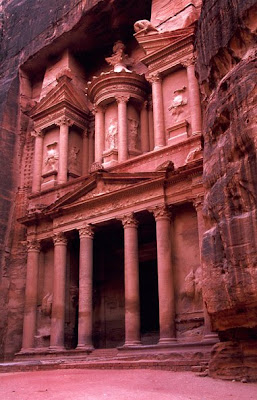
At the end of the Siq, about 1.5km from the gorge entrance, we arrived at the spot where every visitor would stop for the iconic view of the rock-cut Treasury (Al Khazneh). No matter how many times the image of the Treasury has become in the age of mass images, the view is still stunning. While we were taking photos, groups after groups of tourists passed by us and gathered in front of the Treasury. Certainly this is the busiest attraction in Jordan. Unlike the Indiana Jones movie, the interior of the Treasury is a large but empty high ceiling space carved out from the cliff. No labyrinth or traps, only massive blank walls containing magnificent marble-like patterns in colours ranged from white to red to brown. There are legends suggesting robbers and pirates used the building as a treasury of looted objects, and probably it was where the name “Treasury” comes from.

Petra was the capital city of the Nabatean civilization. First as the Nabatean capital and then later as an important Roman trading, Petra reached its prime time from around 100BC to 200AD. The city’s fortunate was closely tied to how well they managed water supplies and how caravan routes had established in the Middle East. In its high time, Petra was a very significant trading city at the west end of the Silk Road, before caravans reached the coast of the Mediterranean. The city flourished as a trading city until the Bride of the Desert, Palmyra, took over its place as trade routes being developed further north in today’s Syria and Lebanon.

2010/11/17

2006.05.20_Petra 1 - Siq


We get up at 06:00 for breakfast. Extremely excited, we were quickly on our way towards the ticket office of Petra down the road. In the itinerary of many Middle East travelers, Petra is perhaps the single most important highlight of their trip. It only took us 5 minutes to reach the ticket office from Petra Moon Hotel, and that was pretty much the only reason for us to stay there. After obtaining our tickets, we walked along a winding and dusty pathway to the entrance of the Siq, a narrow gorge that served as the main entry into Petra. At a few points, the Siq became so narrow and dim that I felt like walking in a tunnel no wider than a car’s lane. From aerial photos one can clearly see how narrow the Siq is – a split in the rose-red sandstone plateau no wider than 3m at some points. In early morning, the rock cliffs seemed to glow in a golden colour. I anticipated the change of colour from gold to red as the day went by. A carved water channel, at about 1m high along the sides of the Siq, was still visible as we walked into the desert city. The water channel was a great engineer infrastructure that led water from flash floods into Petra, where it was stored for daily use.