Showing posts with label Hama. Show all posts

2010/11/08

2006.05.13_Beehive Houses


Our second stop was the Village of Twalid Dabaghein where we visited the unique vernacular architecture - beehive houses. Beehive houses are conical houses made with mud bricks. The mass of the masonry and the high volume of the dome are perfect to keep out the summer heat. We were invited to enter one of the houses for tea. Chickens and a herd of sheep wandered in front of the house. Our host showed us his guest-book and offered us mint tea. As we passed around the sugar and tea pot, I began to observe the interior of the beehive house. The interior was painted mainly in white. A fan was hung from the very top of the spiral brickwork. Several decorations were also hung on the wall, including a poster of former Syrian president Hafez al-Assad and a few textile works. As I finished writing my comment in the guest book, an old man who was the host's neighbour and his young daughter came in the house to chat with us. I brought out my sketchbook and let the old man and his daughter to write something down. I showed them a photo of my birthplace Hong Kong, and they seemed very delighted and curious. That's it. We had some pleasant moments in the beehive house, which was actually quite cool despite the late morning sun outside. At the end, we left some tips for the host.

2006.05.13_Qasr Ibn Wardan


On our return to Cairo Hotel, we passed by a house called as the Palestinian Institute. There was a mural on its front facade, expressing its manifesto in English.

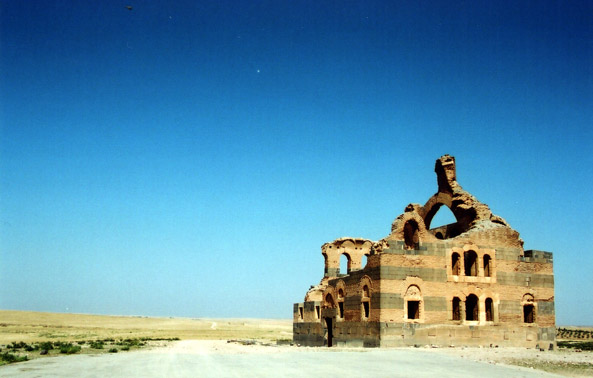
We returned to Cairo Hotel and joined another organized tour by the hotel, a journey that would take us from Hama to our next destination, the desert oasis of Palmyra. The first stop on our way was the Roman ruins of Qasr Ibn Wardan. In the middle of an arid landscape where ancient Romans marked their eastern boundary, Emperor Justinian built this enormous complex in the 6th century attempting to impress the desert nomads. A mixture of local materials and Byzantine styles imported from Constantinople created a magnificent architecture that once encompassed a palace, church and barracks. To the Romans, this site was once a beacon on the border that separated civilized and the uncivilized world. The strips of dark basalt stones on the facades create a strong sense of horizontality against the desert horizon, articulating the grandeur of both the structure and the vastness of the surrounding landscape.

2006.05.13_Norias of Hama


At 06:30 in the morning, HC, MC and I went to check out the famous norias of Hama. We walked through the old town of Hama and reached a bridge where we could take some good photos of the enormous noria structures. The norias are no longer in use for practical purpose. Though in ancient times they were essential to bring water uphill to irrigate farms.

2010/11/07

2006.05.12_Krak des Chevaliers


Before reaching the castle gate, our tour van stopped at a lookout along the highway for us to take photo of the famous Krak des Chevaliers. Krak des Chevaliers, a Crusader castle near the city of Homs, is probably one of the best preserved crusader castles in the world. Even from a distance we could already appreciate the intact outer walls and guard towers of the fortress. The strong castle was protected by two layers of fortress wall. We entered the complex through an entrance in the lower level, then passed through a vaulted tunnel, and reached the inside of the fortress walls. Another tunnel led us up to the core area of the castle where there was a church/mosque. We climbed the guard towers one by one for the outside scenery. We spent about 1.5 hour at Krak des Chevaliers, and it was certainly one of the most impressive fortresses I had ever visited.

The earlier Muslim fortress on the site of Krak des Chevaliers was captured by the First Crusaders. Later, Krak des Chevaliers was subsequently expanded and became the headquarters of Knights Hospitaller during the Crusades. In 1271 the castle was finally fell to the hands of the Muslims and the Gothic church in the complex was turned into a mosque.

Krak des Chevaliers was certainly the day's highlight. After the visit, our van headed back to Cairo Hotel in Hama. In the evening we had fried and grilled chicken for dinner again.

2006.05.12_Musyaf Castle


After Apamea, our van took us to the castle at Musyaf. Situated on a hilltop, the Musyaf Castle was built in Medieval times during the Byzantine era. The castle was conquered and controlled subsequently by the Byzantines, Muslims, and Ottomans. We only made a short stay at the castle before leaving for the biggest highlight of the day, the Krak des Chevaliers.

2006.05.12_Apamea


From Aleppo we took a morning bus to Hama, a beautiful city south of Aleppo and north of Damascus. Under the morning sun and the shade of the palms, olive trees and fruit trees, Hama seemed to me an ideal Middle Eastern city. At first we had a little trouble to get the right orientation. A taxi driver came by and helped us to find the right direction to the clock tower at the town centre and our Cairo Hotel.

Cairo Hotel was clean and the staff was friendly. We joined one of their tour for the Crusade castles and archaeological ruins in the region. Our first stop was Apamea. The ruins at Apamea was massive. From the km-long colonnade we could truly appreciate the scale of the ancient city of Apamea, which was once a significant Hellenistic city with a population of half a million, ruled under the Seleucid kings before Roman conquest. Because of its strategical location on the routes of commerce, the city flourished in ancient times.